

"Rotorua's Parking Privatisation Disaster" A Classic Case of Neoliberal Failure - 10 July 2025
Debunking the myth that market solutions cure public woes

Mōrena ano,
The wasteful cycle of parking privatisation in Rotorua exposes a fundamental truth about neoliberal governance: when public assets are handed to private operators, ratepayers always pay twice. In mid-2018, Rotorua Lakes Council fully outsourced its parking services to i-Park, promising efficiency and cost savings. Seven years later, the council is bringing these services back in-house, marking the complete failure of this privatisation experiment.
This flip-flopping is not merely administrative incompetence – it is the predictable outcome of neoliberal policy that prioritises private profit over public service. The timing of this reversal coincides with a broader housing and cost-of-living crisis that has hit Māori whānau particularly hard, with about a third of working-age Māori unemployed and almost 41 percent not homeowners in a district where some urban suburbs are among the most deprived communities in New Zealand.
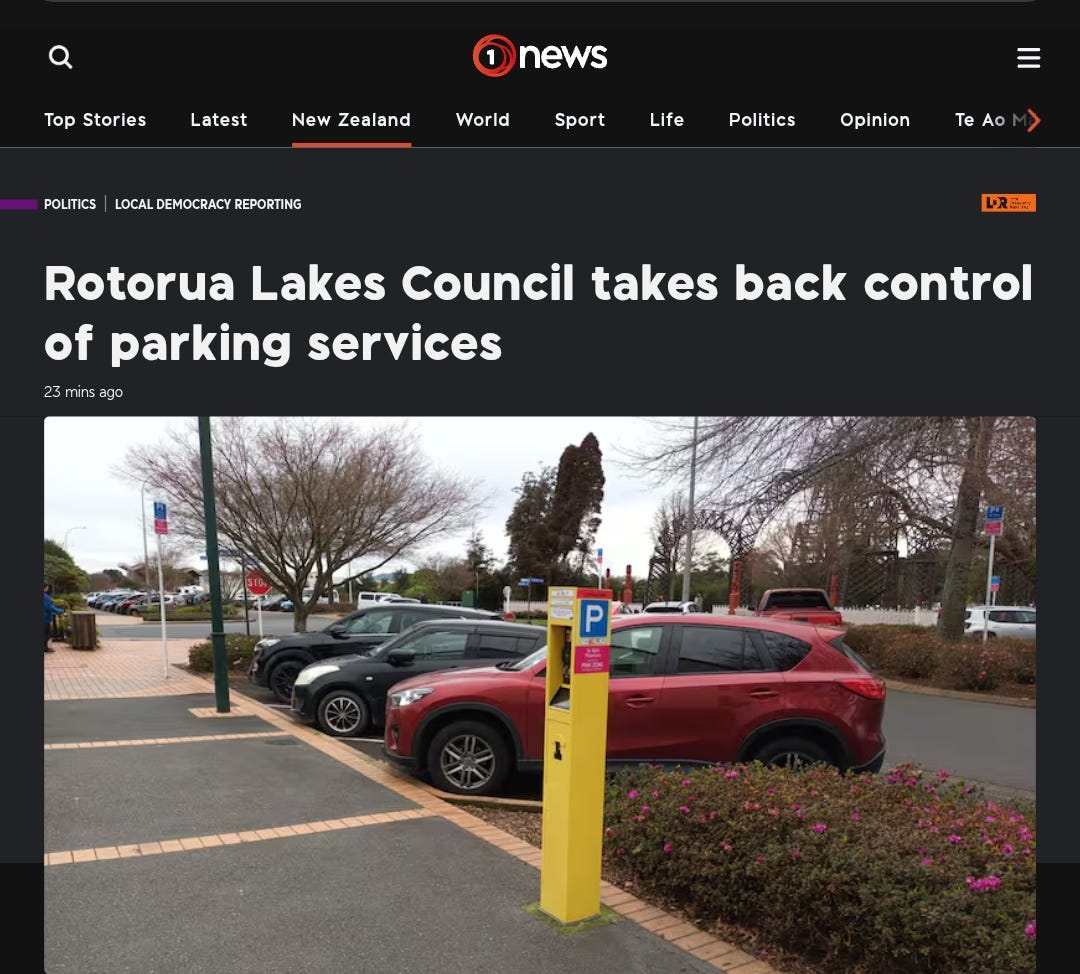
https://www.1news.co.nz/2025/07/10/rotorua-lakes-council-takes-back-control-of-parking-services/
The i-Park parking system was introduced as a supposed modern solution to replace what the council described as "obsolete coin-operated meters that were expensive to operate and maintain." However, the financial reality tells a different story. The i-Park contract cost more than doubled between 2018/19 and 2019/20, from just over $793,000 to more than $1.7 million, consuming almost 84 percent of the council's parking revenue in that year.
The system faced immediate problems: the council waived 2400 disputed parking fines in February 2020 after acknowledging "issues" with the system, while emails revealed "absolute and utter frustration" and about 100 calls a week from people with payment problems. As recently as May 2025, issues with the i-Park app delayed charges and led to some drivers being charged a month's worth of fees at one time.
The Neoliberal Playbook in Action
This parking privatisation follows a familiar neoliberal pattern that has plagued public services worldwide. The justification always sounds reasonable: introduce market competition, reduce bureaucracy, improve efficiency. The reality consistently proves otherwise. Chicago's infamous 75-year parking meter lease to Morgan Stanley for $1 billion exemplifies this failure, with the city ultimately selling the meters $1 billion under their value while parking rates skyrocketed.
Rotorua's experience mirrors these international failures. Former inner-city businessman Mike Steiner described the system as having a "detrimental effect" on the inner city, making people less likely to shop in town because it was "punitive". This reveals how privatisation often undermines the very economic activity it claims to enhance.
The broader context makes this policy choice particularly tone-deaf. While the council was experimenting with parking privatisation, Rotorua ratepayers faced potential average 10.24% rates rises and the district struggled with an overall deprivation rating of eight out of ten.
Impact on Māori Communities
The privatisation of parking services carries particular significance for Māori communities in Rotorua, who make up 40 percent of the district's population. The increased costs and complexity of the privatised system created barriers to accessing the city centre for whānau already facing significant socioeconomic challenges.
The principle of whakatōhea (collective responsibility) stands in stark contrast to the privatised model that prioritises individual profit over community wellbeing. When parking becomes a revenue extraction mechanism rather than a public service, it disproportionately affects those with the least disposable income. This aligns with the broader pattern of neoliberal policies that entrench existing inequalities.
The timing of the privatisation reversal coincides with growing recognition of these inequities. Māori housing quality in Rotorua ranks 56th out of 67 territorial authorities, while more than 18 percent of households lack internet access. In this context, complicated parking apps and card-only payment systems become additional barriers to participation in community life.
The Broader Privatisation Agenda
Rotorua's parking privatisation disaster must be understood within the wider neoliberal assault on public services. From Wellington City Council's decision to bring parking services back in-house after 12 years of outsourcing to concerns about rate caps accelerating asset privatisation, the pattern is clear: privatisation promises efficiency but delivers extraction.
The financial data reveals the true cost of this ideological experiment. Between 2018/19 and 2019/20, the i-Park contract cost increased by 114.4 percent, consuming 85 percent of parking revenue. This represents a massive transfer of public wealth to private operators for no corresponding improvement in service quality.
The Path Forward
The council's decision to bring parking services back in-house represents a victory for common sense over neoliberal dogma. However, the proposed "hybrid model" – where infrastructure and technology remain outsourced while the council directly employs parking wardens – suggests incomplete learning from this expensive lesson.
True reform requires rejecting the fundamental premise that private operators can deliver public services more efficiently than democratically accountable institutions. The principle of kotahitanga (unity) calls for public services that serve community needs rather than private profit.
The proposed one-hour free parking citywide and simplified approach represents a step toward accessibility and community-focused policy. However, deeper questions remain about how transport policy can support rather than hinder community wellbeing.
This parking privatisation failure exemplifies the broader contradictions of neoliberal governance in Aotearoa. While councils face genuine financial pressures, privatisation consistently proves a false solution that exacerbates rather than resolves public sector challenges.
The cost of this ideological experiment extends beyond the millions wasted on contracts. It includes the erosion of public trust, the creation of barriers to community participation, and the normalisation of extractive relationships between private operators and public resources.
As other councils consider similar privatisation schemes, Rotorua's experience serves as a cautionary tale. The promise of efficiency through privatisation is a mirage that consistently leads to higher costs, reduced service quality, and greater inequality.
The parking privatisation debacle in Rotorua exposes the fundamental dishonesty of neoliberal promises. Seven years of private operation produced higher costs, worse service, and community frustration. The decision to return services to public control represents a victory for evidence over ideology.
This expensive lesson must inform future policy decisions. Public services exist to serve community needs, not generate private profit. The principles of whakatōhea and kotahitanga point toward an alternative approach where public resources serve public good.
The next time politicians and consultants promise that privatisation will solve public sector problems, remember Rotorua's parking meters. The market solution created more problems than it solved, at tremendous cost to ratepayers and community wellbeing.
Moving forward, we must demand public services that embody Māori values of collective responsibility and community wellbeing. The privatisation experiment has failed – it's time to build something better.
Nāku noa, nā Ivor Jones
Readers who find value in this analysis and wish to support independent media that challenges neoliberal orthodoxy may consider a koha to HTDM: 03-1546-0415173-000. The MGL understands these are tough economic times for whānau, so please only contribute if you have capacity and wish to do so.
https://www.1news.co.nz/2025/07/10/rotorua-lakes-council-takes-back-control-of-parking-services/
https://www.rnz.co.nz/national/programmes/checkpoint/library?page=24
https://www.1news.co.nz/2024/03/28/rising-rates-left-with-84-a-week-to-live-in-their-own-homes/
https://www.rnz.co.nz/news/ldr/433004/rotorua-parking-system-costs-council-urged-to-apologise
https://www.1news.co.nz/2024/02/03/what-tauranga-rotorua-councils-earn-and-pay-for-parking/
https://sunlive.co.nz/news/288526-the-cost-of-parking-rotorua.html
https://www.sunlive.co.nz/news/336532-what-tauranga-and-rotorua-councils-earn-from-parking.html
https://www.gets.govt.nz/ROTDC/ExternalTenderDetails.htm?id=26737391
https://www.rnz.co.nz/news/ldr/461339/rotorua-lakes-council-almost-6m-in-the-red
https://www.gets.govt.nz/BPRC/ExternalTenderDetails.htm?id=29963553
https://media.nzherald.co.nz/webcontent/document/pdf/201348/PPPStudyForAttachmen1.pdf
https://www.inthepublicinterest.org/wp-content/uploads/ITPI_PerilsofParkingPrivatization_Apr2019.pdf
https://www.nbr.co.nz/auckland-transport-takes-up-the-parking-challenge/
https://www.governing.com/archive/col-public-private-partnership-cincinnati-parking-lease.html
https://www.adriley.co.nz/blog/smooth-ride-for-re-integrating-parking-services-into-wcc
https://www.cbc.ca/news/canada/manitoba/impark-faces-lots-of-competition-1.307802
https://www.rotorualakescouncil.nz/our-council/plans-policies-bylaws/policies
https://nextcity.org/urbanist-news/infrastructure-projects-p3-contracts-chicago-parking
http://media.nzherald.co.nz/webcontent/document/pdf/201722/SPDD_310317_FA_Web.pdf
https://www.rnz.co.nz/news/ldr/506398/danger-of-near-double-digit-rates-rises-in-rotorua
https://www.rnz.co.nz/news/ldr/519783/south-aucklanders-urged-to-speak-up-on-city-s-transport-plan
https://www.rotorualakescouncil.nz/roads-transport/parking/i-park
https://www.teaonews.co.nz/2022/08/15/scary-report-paints-grim-picture-of-rotorua/
https://www.journal.mai.ac.nz/system/files/McKee_FNL_webready.pdf
https://sunlive.co.nz/news/300369-report-paints-grim-picture-of-state-of-rotorua.html
https://waateanews.com/2025/06/13/homelessness-in-rotorua-shaping-as-big-kaupapa/
https://www.1news.co.nz/2024/02/08/the-council-that-slashed-a-proposed-rates-rise-by-two-thirds/
https://www.rnz.co.nz/news/ldr/438106/rotorua-safety-500k-fund-more-cameras-ai-proposed
https://www.rotorualakescouncil.nz/our-council/news/news?item=id%3A2urpnbk251cxbyl8h7di
https://www.rotorualakescouncil.nz/our-council/news/news?item=id%3A2uov8hegc17q9s7q8bgm
https://www.rnz.co.nz/news/national/408936/rotorua-council-admits-parking-system-issues
https://www.1news.co.nz/2024/05/13/some-businesses-blindsided-by-changes-to-auckland-parking-fees/
https://www.1news.co.nz/2024/07/09/affordable-rental-homes-to-be-built-on-former-rotorua-reserve/
https://www.1news.co.nz/2024/06/07/parking-nightmare-drivers-blocking-cars-in-auckland-car-park/
https://www.reddit.com/r/PersonalFinanceNZ/comments/11q1w7m/fighting_private_car_parking_companies/
https://www.1news.co.nz/2024/04/11/rates-burden-the-local-government-funding-model-is-broken/
https://www.1news.co.nz/2024/04/30/end-of-public-transport-subsidies-devastating-as-costs-bite/
https://www.democracyaction.org.nz/rotorua_lakes_council_pushing_for_maori_co_governance
https://www.rotorualakescouncil.nz/property-building-bins/rates-information
https://www.nzta.govt.nz/assets/resources/research/reports/484/docs/484.pdf
https://www.waikatoregion.govt.nz/assets/WRC/WRC-2019/TR201231.pdf
https://assets.education.govt.nz/public/ENP/BOPW-Rotorua.pdf