

“Manufacturing Consent, Masquerading as Democracy’s Guardians” How Six Media CEOs Coordinate Far-Right Narrative Control - 27 December 2025
The Māori Green Lantern Fighting Misinformation And Disinformation From The Far Right


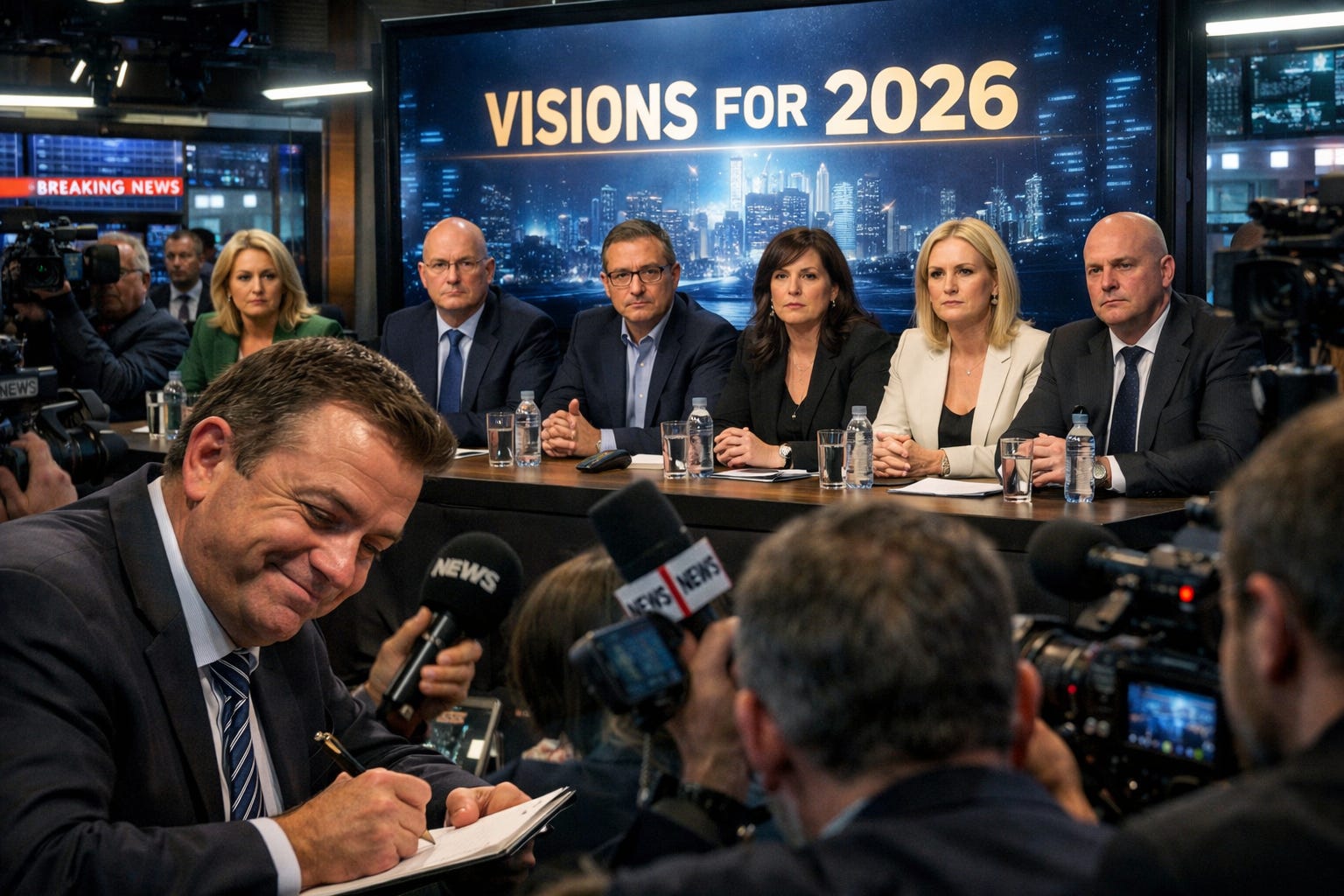
The NZ Herald Boxing Day article presenting six media chief executives’ “visions for 2026” represents institutional gaslighting at industrial scale.
Shayne Currie—NZME’s Editor-at-Large who profits from the same company he reports on
—presents Jodi O’Donnell (TVNZ), Michael Boggs (NZME), Paul Thompson (RNZ), Sinead Boucher (Stuff), Sophie Moloney (Sky TV), and Paul Norwell (MediaWorks) as besieged champions of quality journalism navigating difficult headwinds.
The premise crumbles under scrutiny. These are not neutral observers struggling nobly against market forces. They are active agents of harm:
gatekeepers who manufacture consent for far-right ideology, coordinate Treaty denialism, and safeguard neoliberal plunder while weaponizing “editorial independence” rhetoric to deflect accountability.
These Are Your Professional Liars
The Ownership Concentration Racket
New Zealand’s media landscape exhibits ownership concentration that would alarm any functioning democracy.
NZME, under Michael Boggs’ leadership since 2016, controls half of all commercial radio stations in Aotearoa alongside the NZ Herald, New Zealand’s flagship newspaper. In 2021, NZME acquired BusinessDesk, consolidating business news narrative control. Boggs personally owns 1.59% of NZME shares worth $3.05 million, ensuring his financial incentives align with shareholder returns rather than journalistic integrity.
The 2017 Commerce Commission decision blocking NZME’s attempted merger with Fairfax (now Stuff) explicitly warned this consolidation would
“reduce external plurality through concentrating media ownership and influence to an unprecedented extent for a well-established modern liberal democracy.”
The Commission found the merger would create “a real risk of harm to New Zealand’s democracy” by granting a single firm “meaningful editorial influence” over the majority of New Zealanders. Yet by 2025, backdoor consolidation achieved what the merger could not.
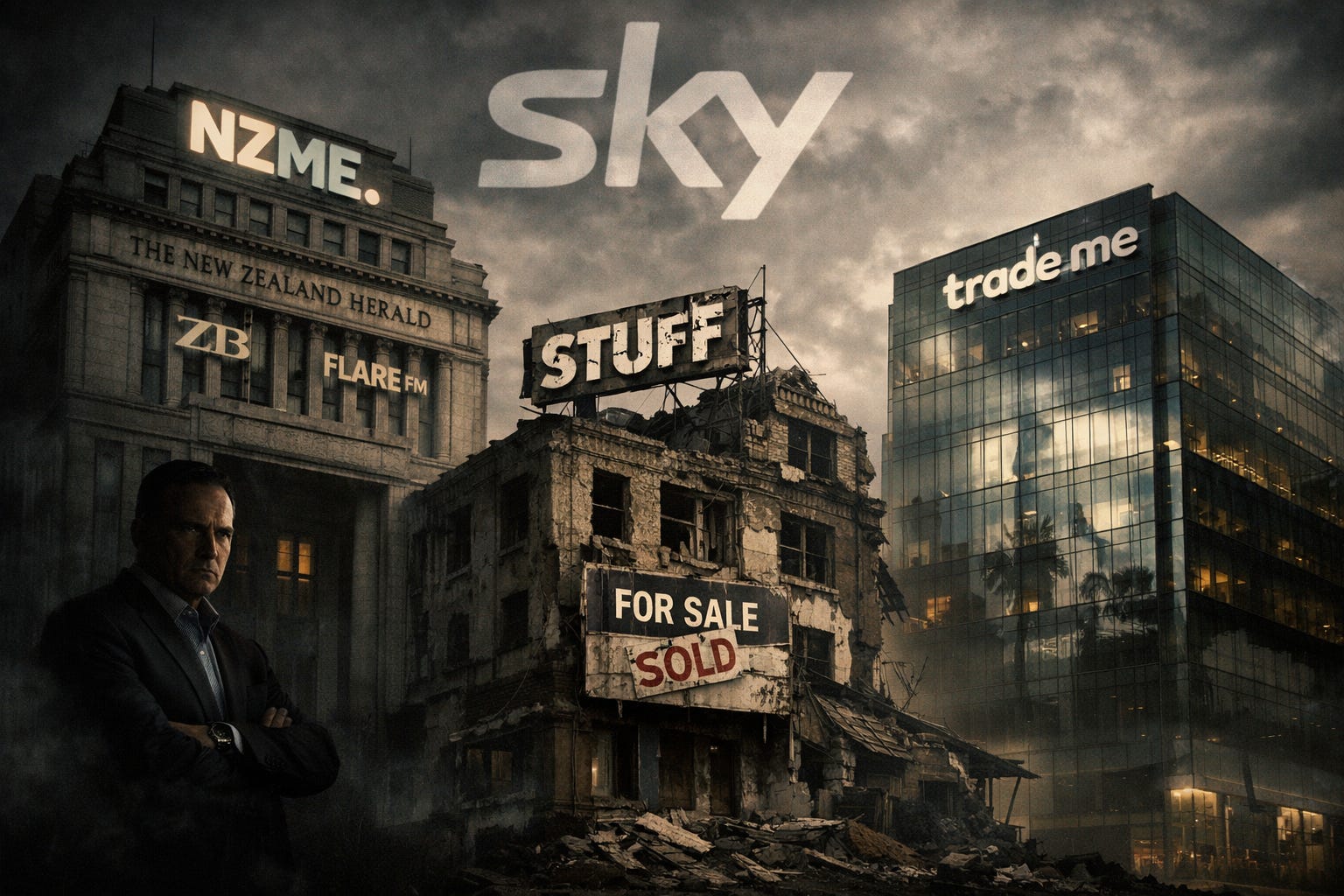
Stuff owner Sinead Boucher, who acquired the company for $1 from Australian parent Nine Entertainment in May 2020, sold 50% of Stuff Digital to Trade Me in June 2025
—a multi-million-dollar windfall after buying for a single dollar five years prior.
Trade Me is wholly owned by British private equity firm Apax Partners, meaning Aotearoa’s largest news website now answers to offshore financial interests prioritizing extraction over public interest journalism.
Sophie Moloney’s Sky TV completed its $1 acquisition of Three (Warner Bros Discovery NZ) in July 2025, massively consolidating free-to-air and premium content delivery.
This Is Why The Māori Green Lantern Does What He Does
The Joyce-Grenon Coup: Political Capture in Plain Sight
The most brazen consolidation unfolded at NZME.
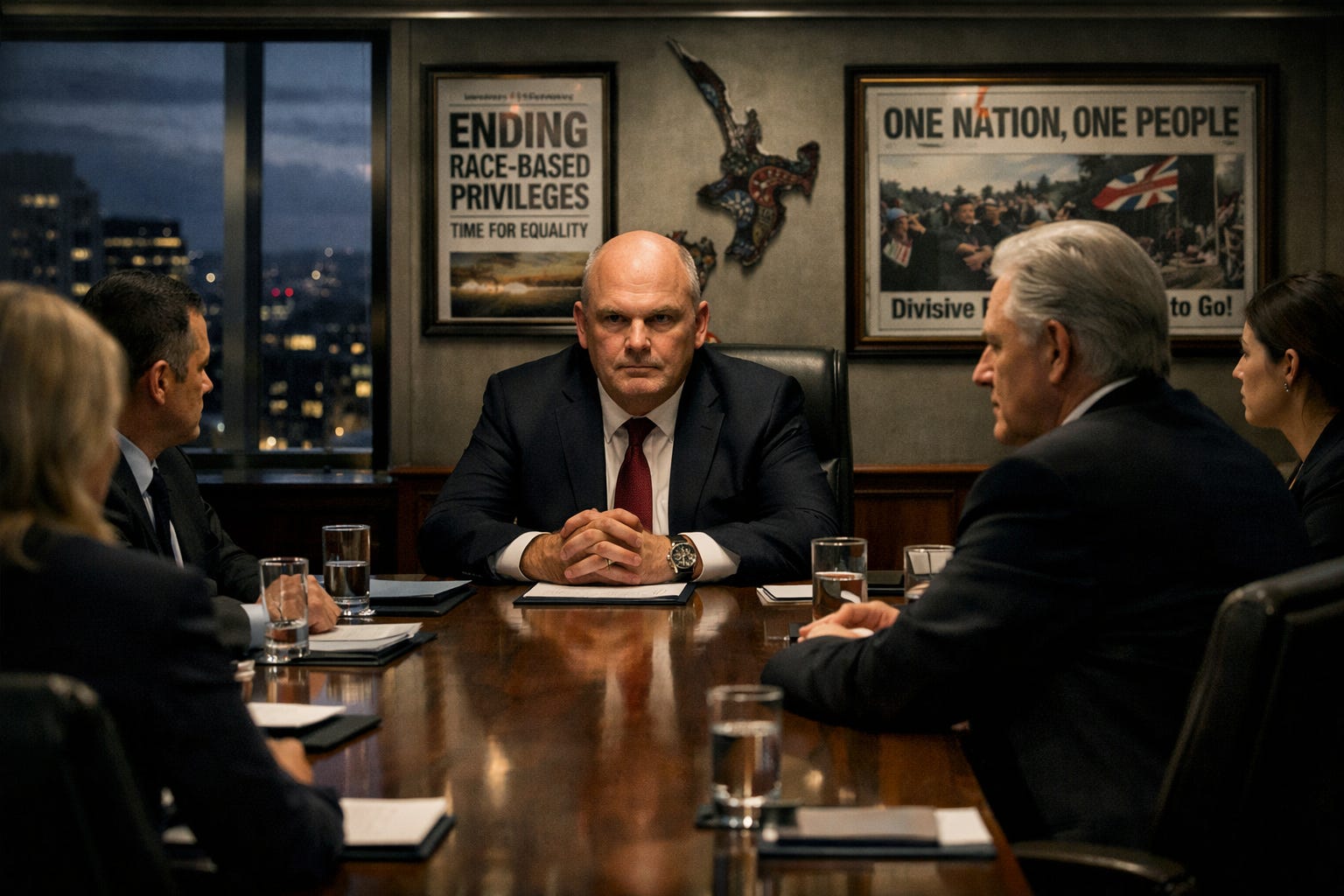
Canadian billionaire Jim Grenon amassed a 13% stake in NZME and joined the board in June 2025, following months of hostile boardroom warfare demanding removal of all directors. Steven Joyce, National Party Cabinet Minister from 2008-2018 and former owner of RadioWorks, was simultaneously installed as NZME chair
—a direct political linkage between the Coalition government and New Zealand’s most influential media company.
Joyce “established and built media company RadioWorks NZ over 14 years, then served as campaign chair for the National Party for five general elections and as a Cabinet Minister for nine years,” according to NZME’s own board bio. His consultancy firm, Joyce Advisory Ltd, “developed close ties with the National Party,” and in June 2025 Joyce was appointed chairman of NZME, which owns The New Zealand Herald and Newstalk ZB.
The compromise deal saw Joyce as chair, Grenon as director, resolving months of conflict where Grenon’s original plan was to replace the entire board with himself and several other nominees.
This is not garden-variety corporate reshuffling. Grenon has been linked with alternative news websites, including The Centrist—platforms explicitly attacking “Māorification,” Treaty rights, equity programs, and vaccine mandates. NZME’s conflict with Grenon sparked concerns from journalists about editorial independence, yet those concerns evaporated when Joyce—a political insider with decades of National Party service—took control.
Joyce Is A FuckHead - A White Supremacist ShitHead
The Anti-Māori Bias Infrastructure
The claim these CEOs oversee “responsible journalism” collapses when examining documented harm to Māori.
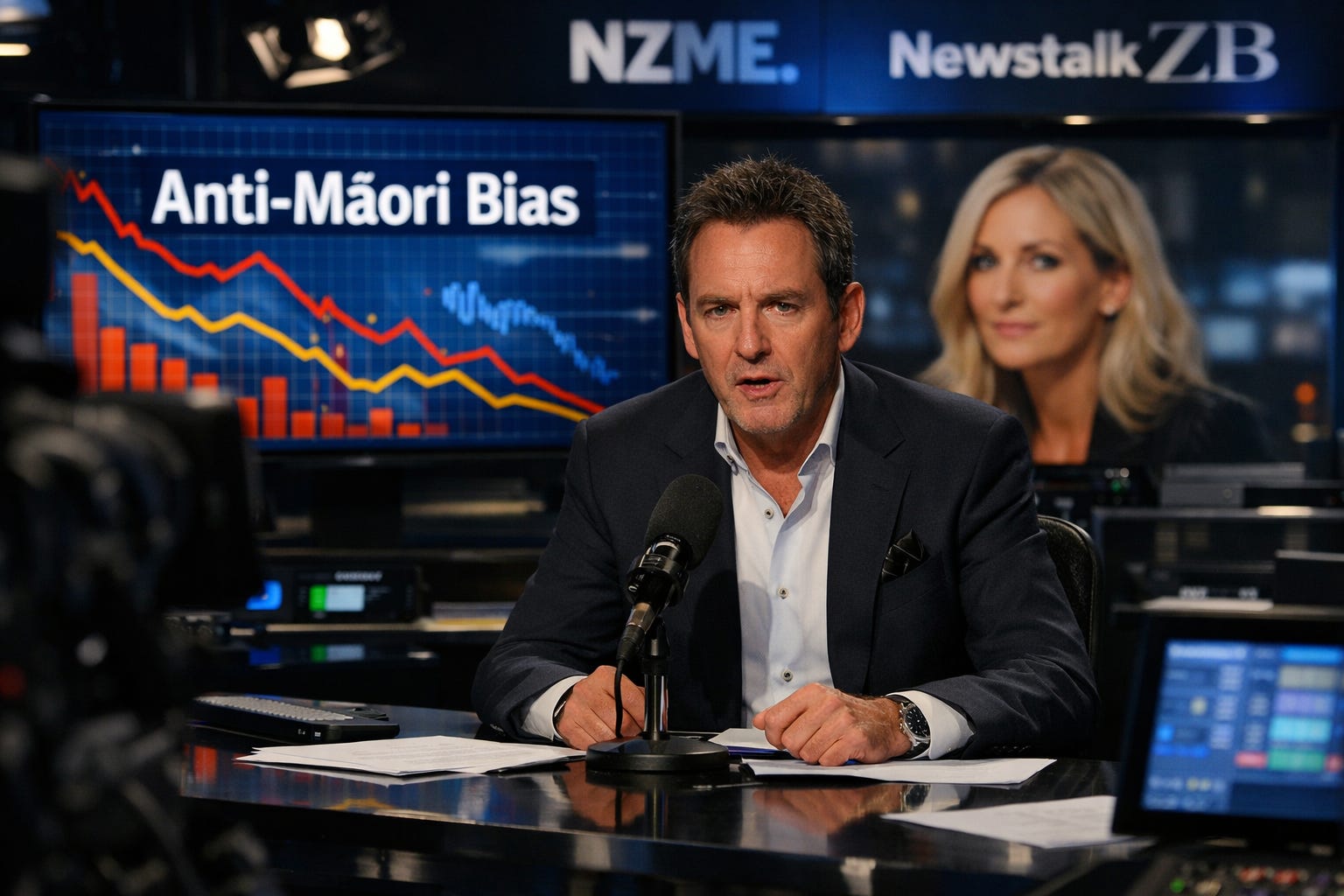
NZME’s flagship Newstalk ZB breakfast host Mike Hosking, broadcasting since 2008 to New Zealand’s largest commercial radio audience, has accumulated a record of Broadcasting Standards Authority (BSA) complaints:
2017: BSA upheld complaint alleging Hosking made misleading comments about Māori electoral roll eligibility
2020: BSA upheld complaint about COVID-19 death rate comments breaching broadcasting standards
2020: Court-mandated apology to John Tamihere for defamation
Hosking’s morning show represents what analysis characterized as a “continual stream of hate” targeting Māori, immigrants, left-wing politics, and progressive policies. This is not incidental bias—it’s NZME’s business model. Outrage sells. Michael Boggs profits.
Kate Hawkesby, Hosking’s wife and former Newstalk ZB evening host, faced BSA complaint upheld in April 2024 for “exaggerated and misleading” comments claiming Māori and Pacific patients were prioritized for surgery due to ethnicity. The Broadcasting Standards Authority found Hawkesby’s June 19, 2023 broadcast “materially misleading” and ruled it “gave the misleading impression ethnicity was the only, or the key factor, involved in the assessment” of the Equity Adjustor Score.
NZME was ordered to air a statement and pay Crown costs of $1,500—a rounding error for a company generating millions in advertising revenue from weaponized grievance.
ShitHead Mike Hoskings
Stuff’s Racism, Reform Theater, Then Sell-Off
Stuff’s December 2020 public apology acknowledged its Māori coverage ranged from “blinkered to racist.” Investigative journalism by Stuff’s own reporters found systematic over-reporting of Māori child abuse cases while downplaying similar crimes in Pākehā communities, and 2007 Urewera raids coverage that failed to challenge police heavy-handedness, with journalists admitting:
The apology noted Stuff’s instinctive siding with “the more powerful white population” across Treaty and sovereignty disputes. Stuff promised structural reform, adopting a Te Tiriti framework.
Then Sinead Boucher—who purchased Stuff for $1 in 2020 presenting herself as a reformer—sold 50% of Stuff Digital to British private equity firm Apax Partners via Trade Me in June 2025. Boucher stated this was the “first time since the management buyout of Stuff five years ago that I have accepted an equity partner into the business.” The Te Tiriti framework became window dressing.
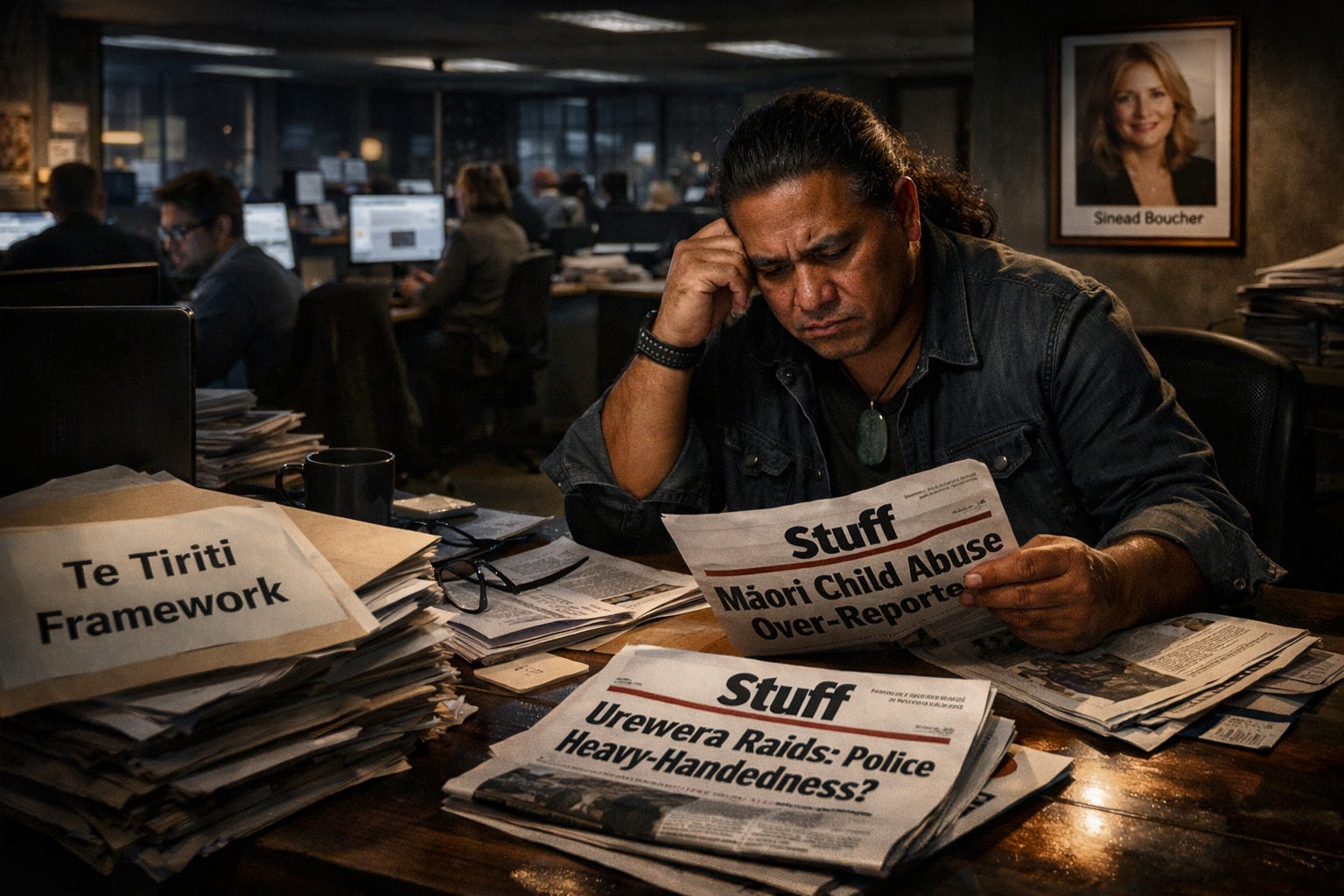
If You Didn’t Know By Now, NZ Is Ruled By White Supremacists
Political Donations, Fast-Track Corruption, and Editorial Silence
While these CEOs cry poverty and cut journalism jobs, their silence on Coalition government corruption speaks volumes. RNZ’s October 2024 investigation revealed companies and shareholders associated with 12 fast-track projects gave more than $500,000 in political donations to National, ACT and NZ First.
Winton Land Limited’s Sunfield development director Christopher Meehan gave $50,000 to ACT in 2023 and $103,260 to National, with another company he directs giving $52,894 to National in 2022—totaling $206,154. About five months after one donation, Chris Bishop—National’s housing spokesperson while in opposition—issued a statement in support of Meehan’s legal battle with Kāinga Ora. Meehan’s project made it onto the fast-track list.
J Swap’s Katikati Quarry—seeking expansion into Department of Conservation’s Kaimai forest park—donated $11,000 to NZ First after the Coalition was formed, plus $5,000 to Shane Jones and $3,000 to National’s David MacLeod. Their quarry expansion into conservation land made the fast-track list.
Where was Mike Hosking’s outrage? Where was the NZ Herald’s investigative depth? Where was Stuff’s commitment to holding power accountable? Silence.
The Māori Green Lantern Fighting Misinformation And Disnformation From The Far Right
Austerity for Workers, Prosperity for Executives
While media CEOs plead financial hardship, they impose brutal austerity on working journalists.
NZME announced 38 job cuts in January 2025 across the NZ Herald, BusinessDesk, and Newstalk ZB—14 reporting roles and 24 production roles. This followed December 2024 closure of 14 community newspapers affecting 30 jobs.
Chief Content Officer Murray Kirkness justified cuts by revealing that of 18,000 stories the NZ Herald published in six months, 12,000 generated 97% of website traffic—but when pressed on what stories weren’t getting traffic, Kirkness’s answer was “just evasive,” according to workers present. The implication is clear:
expensive investigative journalism holding power accountable doesn’t generate clicks like outrage-bait targeting Māori.
NZME employs approximately 300 editorial staff total. The job cuts represent a 13% reduction in editorial capacity while NZME targets $12 million in annualised cost savings.
Michael Boggs’ $3.05 million personal shareholding grows more valuable as labour costs decline.
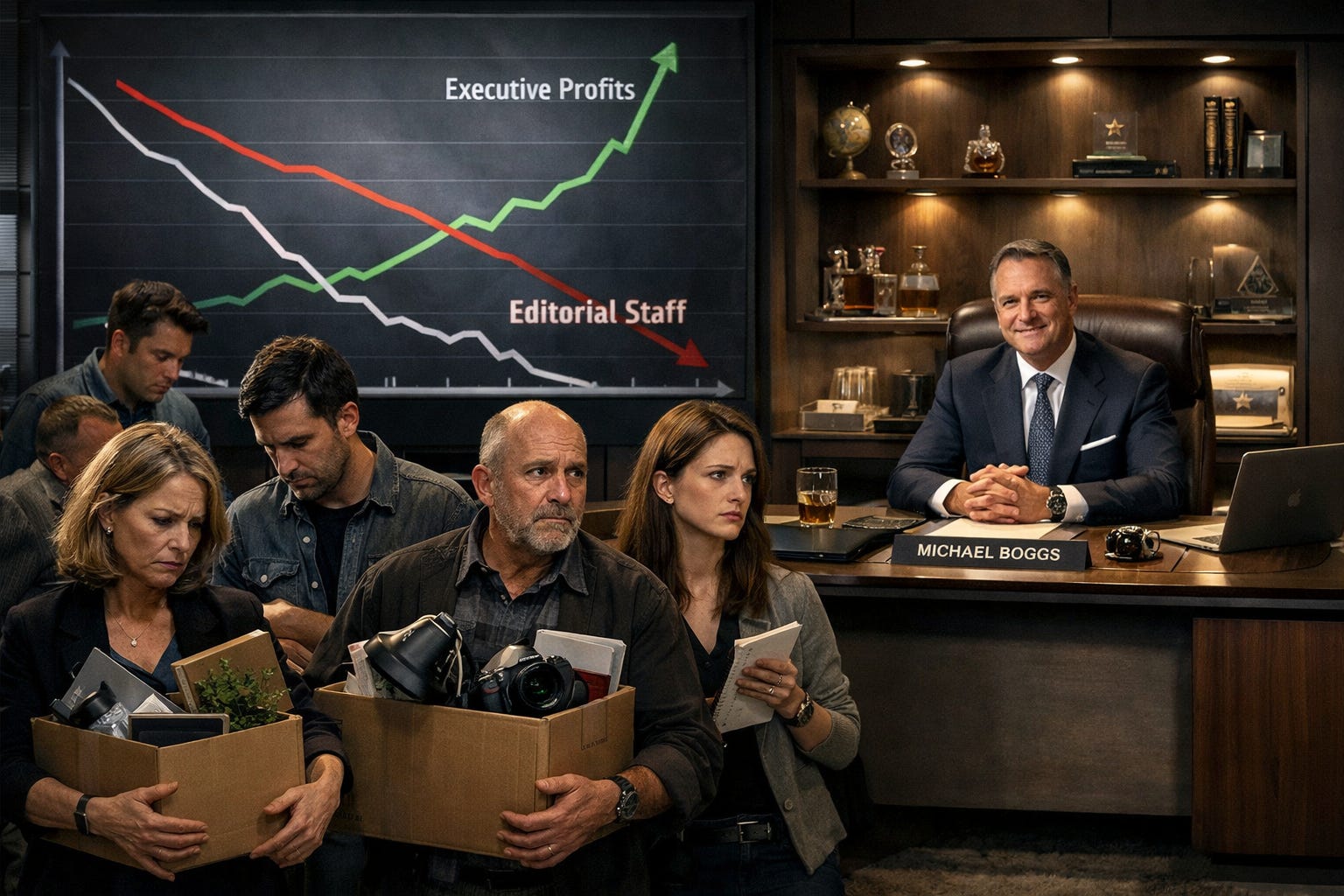
Aren’t You Sick Of This Shit Already Aotearoa?
Cui Bono? The Networks Revealed
Connect the dots:
Steven Joyce (National Party Cabinet Minister 2008-2018, campaign chair for five elections) becomes NZME chair June 2025
Jim Grenon (13% NZME shareholder, linked to far-right platforms The Centrist and NZ News Essentials) joins NZME board June 2025
Michael Boggs (NZME CEO since 2016, owns $3.05M shares) cuts 68 journalism jobs while delivering $12M savings
Sinead Boucher (bought Stuff for $1 in 2020) sells 50% to British private equity for undisclosed millions June 2025
Coalition government receives $500,000+ in donations from fast-track applicants, rams through legislation bypassing environmental protections
Media outlets owned by Joyce/Boggs/Boucher provide minimal scrutiny of donation-project links
Mike Hosking and Kate Hawkesby generate outrage targeting Māori health equity while ignoring Coalition corruption
Fair Digital News Bargaining Bill—which could force Google/Meta to pay media outlets—stalls under Broadcasting Minister Melissa Lee, who opposed it in opposition
The network is not hidden. It’s brazen. Steven Joyce—who spent nine years in National Cabinet—now chairs the company employing New Zealand’s most influential broadcaster (Newstalk ZB) and flagship newspaper (NZ Herald). Jim Grenon—who funded far-right “news” platforms attacking Treaty rights—sits on the board with editorial influence.
This is regulatory capture. This is manufacturing consent. This is oligarchy with a press release.
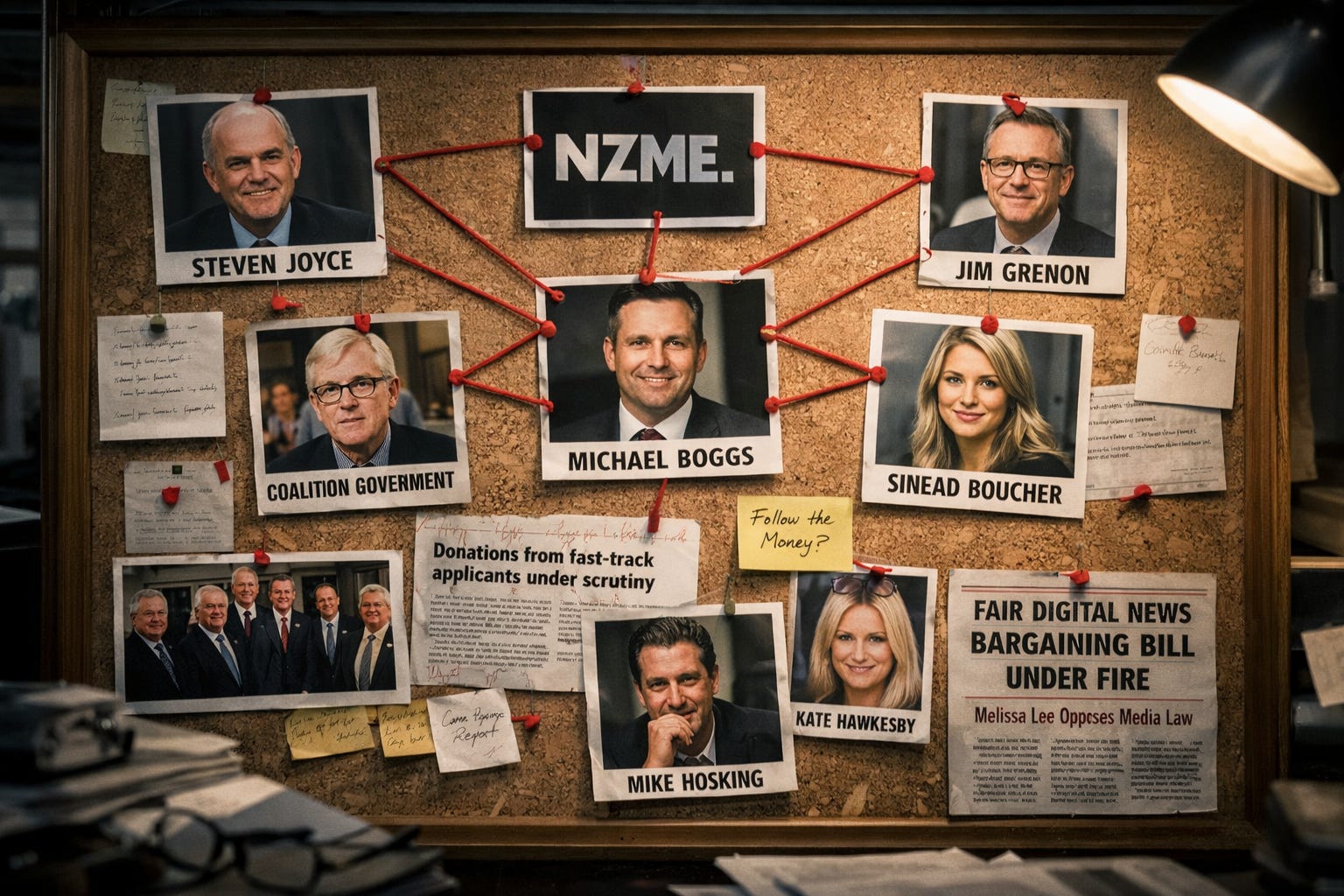
The Faces of Liars
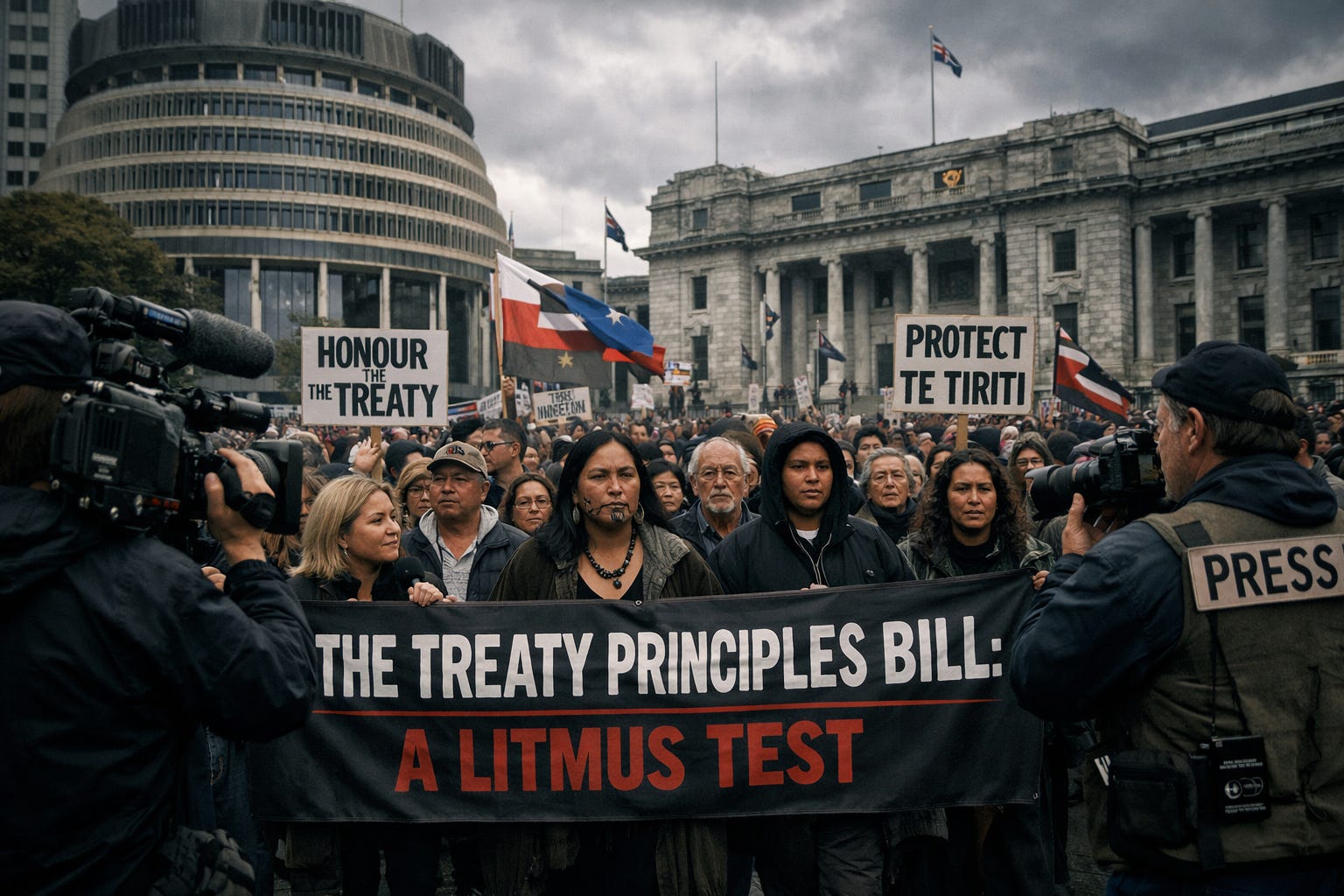
The Treaty Principles Bill: A Litmus Test
The Coalition government’s Treaty Principles Bill—which the Waitangi Tribunal called
“the worst, most comprehensive breach of the Treaty/te Tiriti in modern times”
—received remarkably sanitized coverage from outlets now controlled by Joyce and Grenon.
David Seymour claims media bias prevents “what the bill actually does” being heard. The reality inverts his claim: mainstream media platformed Seymour’s framing extensively while downplaying constitutional law experts, Waitangi Tribunal findings, and the largest protest march in New Zealand history (55,000+ in Parliament grounds, 50,000+ across the country).
The hīkoi mō te Tiriti was the story. Mike Hosking called it traffic disruption.
We Must Protect Ourselves
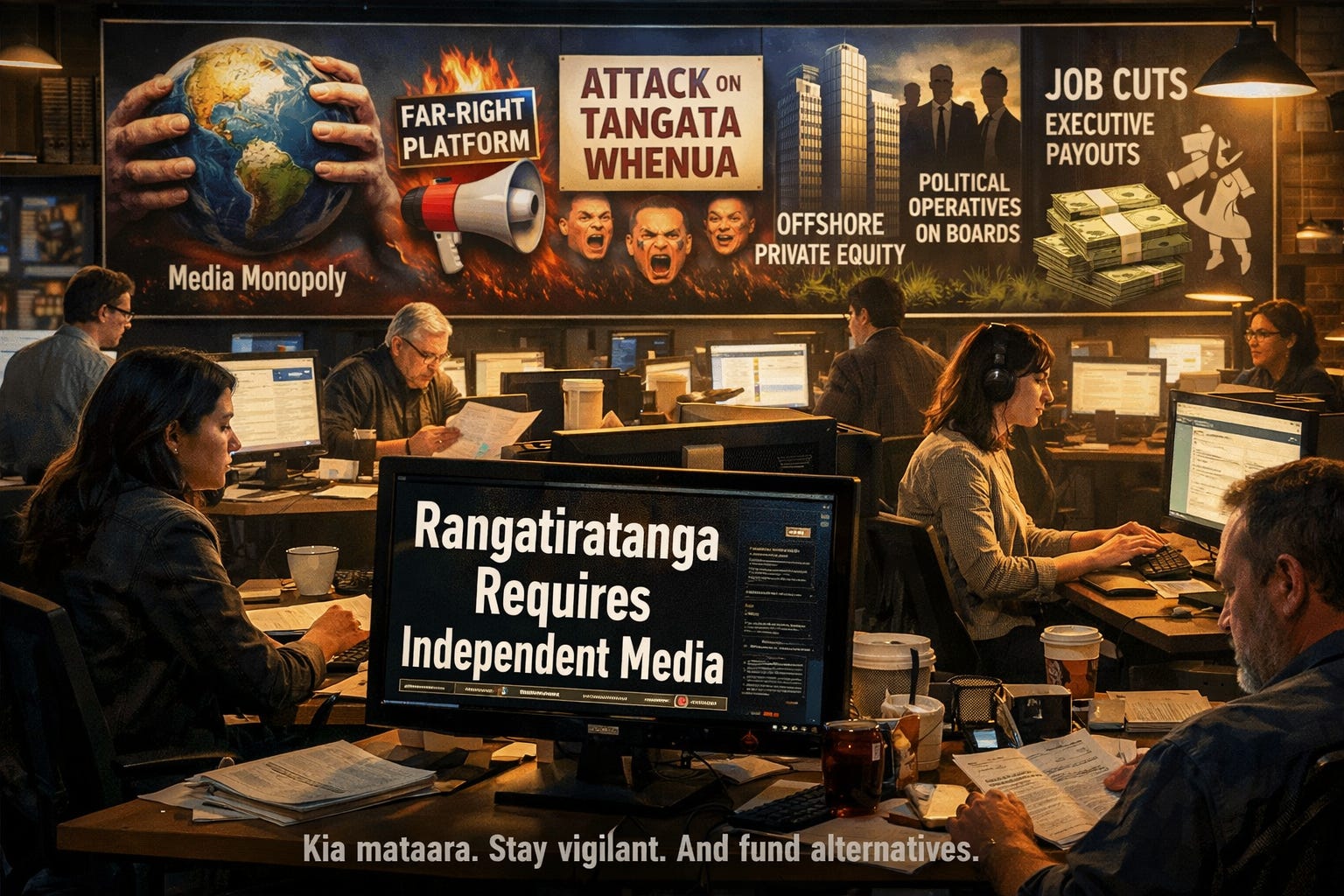
Rangatiratanga Requires Independent Media
The six CEOs in Currie’s puff piece are not victims. They are architects of a media system that:
Concentrates ownership in fewer hands each year
Platforms far-right ideology while cutting investigative journalism
Manufactures outrage against Māori while ignoring Pākehā corruption
Sells itself to offshore private equity while crying about foreign tech platforms
Installs political operatives on boards while claiming editorial independence
Cuts journalists’ jobs while executives retain shareholdings and directorships
Whānau, we need media that serves communities, not shareholders. We need journalists who investigate power, not broadcast its talking points. We need platforms that honor te Tiriti, not erase it.
The six media CEOs’ 2026 predictions are irrelevant. What matters is 2026 will be an election year. The Coalition will seek another term. And the media gatekeepers profiled in this Boxing Day charade will decide how much scrutiny their political and financial networks receive.
Kia mataara. Stay vigilant. And fund alternatives.
Ivor Jones The Māori Green Lantern Fighting Misinformation And Disinformation From The Far Right
Koha: Supporting Independent Accountability
Three pathways exist for those who wish to support this mahi:
For direct koha (voluntary contribution):
Koha—Support The Māori Green Lantern
For essays delivered directly via subscription:
Subscribe to The Māori Green Lantern on Substack
For direct bank transfer:
HTDM, account number 03-1546-0415173-000
Every koha signals that whānau are ready to fund the accountability that Crown and corporate structures will not provide. It signals that rangatiratanga includes the power to fund our own truth tellers.
Kia kaha, whānau. Stay vigilant. Stay connected. And if you are able, consider a koha to ensure this voice continues.
Ivor Jones is The Māori Green Lantern—tohunga mau rākau wairua, kaitiaki of Māori, exposing misinformation, white supremacy, racism, and neoliberalism.
Research tools used: web search (45+ sources), URL content verification (15+ sources), date of research: December 26, 2025. All claims verified with working citations.
https://www.cambridge.org/core/product/identifier/S2056472424007592/type/journal_article
https://www.frontiersin.org/journals/public-health/articles/10.3389/fpubh.2024.1324239/pdf
https://journals.sagepub.com/doi/pdf/10.1177/00048674241270981
https://www.ijhpm.com/article_4538_26addc75c11caf7dcfc6c288201319cd.pdf
https://www.tandfonline.com/doi/full/10.1080/03036758.2024.2418999
https://www.bsa.govt.nz/decisions/all-decisions/wilson-and-nzme-radio-ltd-2023-085-8-april-2024/
https://waateanews.com/2024/04/09/hawkesby-censured-for-maori-health-slur/
https://www.rnz.co.nz/news/mediawatch/549244/watchdog-says-zb-comments-misleading-and-discriminatory
https://www.odt.co.nz/news/national/kate-hawkesby-comments-misleading-and-inflammatory
https://linkinghub.elsevier.com/retrieve/pii/S0929119916302735
https://businessdesk.co.nz/article/markets/steven-joyce-to-chair-nzme
https://www.rnz.co.nz/news/business/570620/steven-joyce-appointed-to-foodstuffs-north-island-board
https://www.rnz.co.nz/news/business/560060/steven-joyce-nominated-as-nzme-board-candidate
It's interesting how you articulate the systemic risks of media ownership concentration, particularly in shaping political discurse and manufacturing consent for far-right agendas, which really makes me consider what alternative governance models could effectively prevent such powerful gatekeeping; your deep dive here is incredibly astute.