

"INVISIBLE VIOLENCE: HOW CHRISTOPHER LUXON'S GOVERNMENT IS CRIMINALIZING POVERTY WHILE PROFITING FROM HOMELESSNESS" - 5 November 2025
THE BANISHMENT STATE: LUXON'S GOVERNMENT CHOOSES POLICE OVER HOMES—AND NAMES THE CULPRITS

Kia ora e te whānau,

The government of Aotearoa is preparing to criminalize the existence of our most vulnerable whānau through so-called “move-on orders” that would give police powers to forcibly remove homeless people from Auckland’s CBD. This is neoliberalism in its purest, most vicious form: making poverty invisible by punishing the poor while corporate landlords and property speculators like Prime Minister Christopher Luxon—who owns seven properties worth between $21-30 million—profit from the housing crisis they helped create. As rough sleeping in Auckland has exploded by 90% in eight months from 426 to 809 people, and Māori make up 43% of Auckland’s homeless despite being only 17% of the population, this government responds not with homes but with police.[1][2][3][4][5]
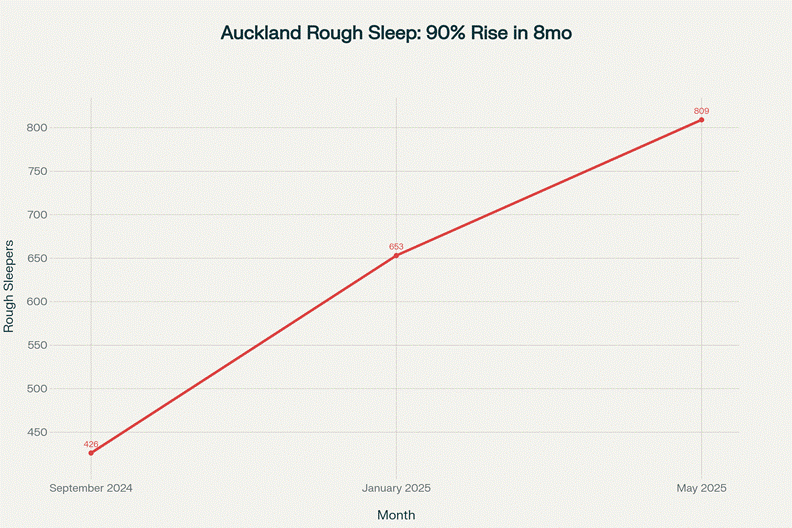
Auckland rough sleeping has increased 90% from September 2024 to May 2025, coinciding with government policy changes to emergency housing.
The Whakapapa of State Violence Against the Poor
This is not new. The colonial state has always criminalized those it dispossesses. The Vagrant Act 1866 made homelessness itself a crime in early colonial Aotearoa. The Suppression of Rebellion Act 1863 imprisoned Māori defending their whenua, then confiscated that land, creating the conditions for intergenerational poverty and homelessness that persist today. The through-line is clear: the state uses law to manage the human wreckage created by capital accumulation and land theft.[6][7]
Today’s crisis has precise financial coordinates. Since August 2024, the Coalition Government implemented “Tightening the Gateway into Emergency Housing“, slashing emergency housing households by 75%—from approximately 3,500 in August 2023 to 875 by mid-2024. The result? A 386% increase in emergency housing denials on the basis that people “contributed to their homelessness”, and rough sleeping that nearly doubled in Auckland alone.[8][9][10][2][11][12]
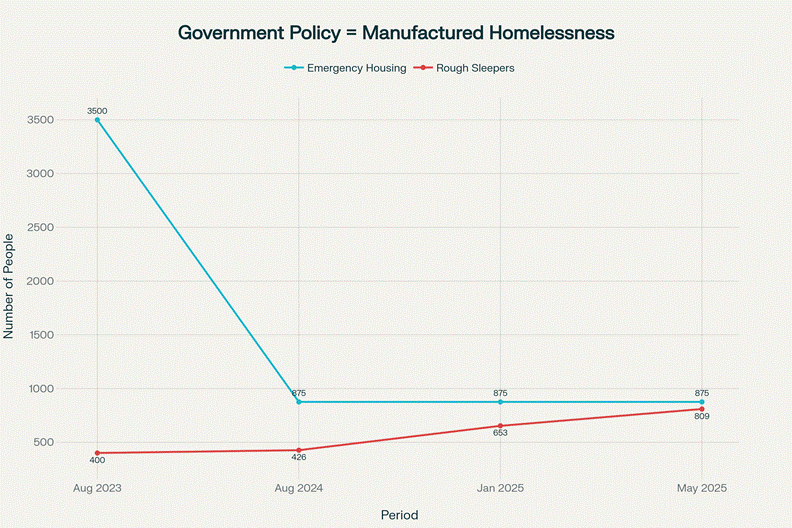
As the government slashed emergency housing by 75% (from 3,500 to 875 households), Auckland rough sleeping doubled from 400 to 809 people.
The numbers expose the lie. While Housing Minister Chris Bishop—former tobacco lobbyist for Phillip Morris—announced 300 new Housing First places in September 2024, only two had been delivered by November. Meanwhile, 985 people languish on the Housing First waitlist, 37.8% homeless for three years or more.[13][14][15][16]
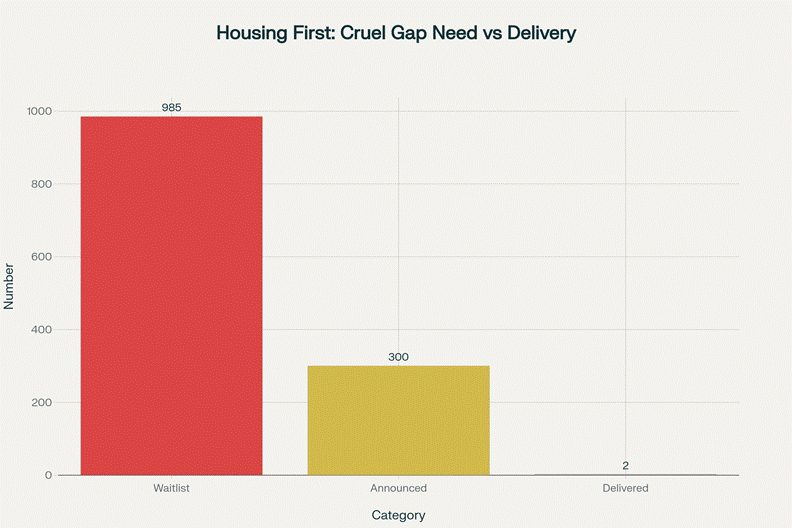
While 985 people wait for Housing First support and 300 new places were announced in September 2024, only 2 had been delivered by November 2024.
The Business of Banishment: Who Profits from Invisible Poverty
At the center of the push for move-on orders sits Heart of the City, Auckland’s CBD business association funded by a targeted rate on commercial property owners. Chief Executive Viv Beck—who earns her salary from ratepayer funds collected from Auckland’s wealthiest property owners—has been campaigning aggressively against visible homelessness. In October 2025, a Heart of the City survey of 100 businesses claimed 91% were “impacted” by rough sleeping and begging.[17][18][19]
Follow the money. Heart of the City’s major funder Andrew Krukziener, a commercial landlord who donated $107,000 to mayoral candidate Viv Beck’s failed 2022 campaign, also donated $22,000 to National in June 2023. This is the same business improvement district model exported globally as urban neoliberalism—using state power to clear “undesirable” populations from spaces being prepared for gentrification and capital investment.[20][21][22]
The architects of this cruelty have names and histories. Justice Minister Paul Goldsmith, trained historian and biographer of right-wing business figures, has tasked himself with giving police “tools” to “tackle public disorder”. His record? Cutting legal aid funding for Māori cultural reports from $40,000 in 2017 to over $7 million—calling it a “cottage industry”. Police Minister Mark Mitchell, former mercenary who ran a security company in Iraq, enthusiastically backs giving police powers to move homeless people to “places of safety”—without clarifying where these places exist.[1][23][24][25]
National MP Ryan Hamilton has introduced a member’s bill giving police powers to direct people to leave areas for 24 hours if their presence causes “distress, disorder or nuisance”. Hamilton—the same MP who claimed in 2016 that water fluoridation was pointless because “most lower socio economics fill their tap water with Raro”—now wants police to move on the very people impoverished by his government’s policies.[26][27][1]
Tikanga Violated: The Assault on Manaakitanga and Whanaungatanga
Every principle of tikanga Māori stands in opposition to this cruelty. Manaakitanga demands we care for the vulnerable. This government criminalizes them. Whanaungatanga recognizes our collective responsibility to whānau. This government blames individuals for “contributing to their homelessness” when they flee domestic violence or lose jobs in an economy with 12.1% Pacific unemployment—double the national rate.[28]
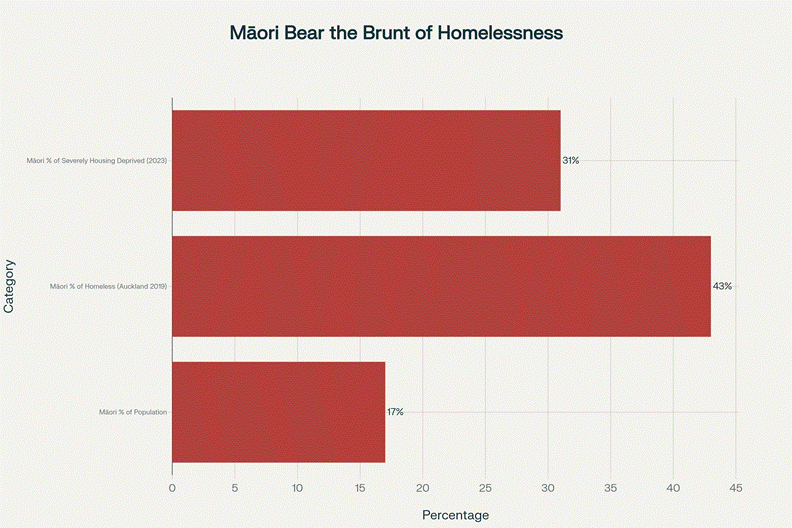
Māori make up 17% of the population but represent 43% of Auckland’s homeless and 31% of all severely housing deprived New Zealanders.
Kaitiakitanga requires us to protect and sustain. The Coalition has spent $20 million less on emergency housing support while rough sleeping surges. Rangatiratanga affirms the mana and dignity of all people. Move-on orders reduce human beings to mobile nuisances to be cleared from view. Aroha compels compassion. This government offers only handcuffs.[29]
The evidence from international jurisdictions is damning. In Victoria, Australia, move-on powers disproportionately target homeless people simply because they are more visible, creating a revolving door between homelessness and the criminal justice system. Research shows one Western Australian client received 104 move-on orders. Tauranga’s begging and rough sleeping ban—introduced in November 2018—was so indefensible under the Bill of Rights Act that the council voted 6-4 to revoke it in February 2020.[30][31][32][33]
The Neoliberal Script: Punishing Poverty, Rewarding Wealth
This follows a global pattern documented by sociologist Loïc Wacquant in Punishing the Poor: as the neoliberal state withdraws welfare support, it expands punitive control. The “centaur state” is permissive at the top—$2.9 billion in tax cuts for landlords through restored interest deductibility and reduced bright line tests—and punitive at the bottom.[34][20][35][36]
Luxon himself embodies this. His property portfolio gained $4.34 million in paper value in 2021 alone—15 times his parliamentary salary. He sold his Wellington apartment for $180,000 more than he paid, potentially avoiding tax because his government changed the bright line test from 10 to 2 years. When challenged about lowering rents despite restoring landlord tax breaks, Luxon was “unsure”. He owns multiple properties mortgage-free while 112,496 New Zealanders—2.3% of the population—experience severe housing deprivation.[37][38][39][40][34]
The broader National donor network reveals who this government serves. In 2023, National raised $10.4 million in donations, more than double any other party. Auckland businessman Warren Lewis gave $500,000. Billionaire Graeme Hart contributed $150,000 personally and $100,000 through his Rank Group company. Property developer Andrew Krukziener: $22,000. These are the interests being served when “disorder” in the CBD is defined not as homelessness itself but as its visibility.[41][42][22]
The Rhetoric of Disposability
The language matters. Justice Minister Goldsmith claims it’s “blindingly obvious” that CBDs are “characterized by disorder”. This rhetorical move reframes human suffering as aesthetic disruption. Police Minister Mitchell promises to take people not to “another vulnerable position” but to “places of safety”—without naming a single such place or allocating funds to create them. Housing Minister Bishop says he wants Auckland CBD to be “a place people are proud of,” as if pride requires the erasure of poverty rather than its alleviation.[1][43]
This is the “just world fallacy”—the assumption that people sleeping rough must have done something to deserve it, that they’ve “contributed to their homelessness.” It erases structural causes: the $70 million cut in transitional housing spending compared to the previous year, the 1,527 canceled Kāinga Ora builds, the tightened emergency housing criteria that reject people for not “foreseeing” their circumstances.[44][45][46]
Auckland City Missioner Helen Robinson states the obvious: “People who are rough sleeping are human beings, and any kind of enforcement approach is not only not good, but it’s also ineffective”. Housing First Auckland programme manager Rami Alrudaini warns that enforcement approaches “only displace the problem and cause more harm”. Yet ACT leader David Seymour—who wasn’t even consulted on the rough sleeping ban proposals—asks the right question: “If you ban homelessness, where do people actually go?”[43][1]
The answer is they go nowhere. They simply become criminals in the only home they have: public space.
Hidden Connections: The International Neoliberal Playbook
This is not isolated policy. It’s part of coordinated international neoliberalism that treats urban space as a commodity and poverty as a crime. Business Improvement Districts—the model funding Heart of the City—originated in North America and spread globally as a mechanism to subordinate public space to commercial interests. The 1996 Atlanta Olympics saw anti-loitering statutes used to “clean” the city of homeless people. The 2018 Gold Coast Commonwealth Games forced homeless people out of Queensland into New South Wales.[47][48]
The Coalition’s gang legislation—which Hamilton champions—employs the same logic of banishment. The Gangs (Insignia Prohibition) Bill, the proposed protests-at-homes ban, the sentencing “reforms” capping discounts and removing remorse considerations—all construct a legal architecture of exclusion. When combined with Housing First’s 985-person waitlist and only 2 delivered homes, the message is clear: if you are poor, brown, or homeless, you are surplus to the neoliberal city.[49][50][51]
Quantified Harm: The Human Cost in Real Numbers
The data is devastating:
· 112,496 New Zealanders severely housing deprived as of March 2023 Census, up from 99,462 in 2018
In Rotorua alone, 1,500 people—over 1% of the city’s population—were estimated homeless in December 2023. Christchurch City Mission recorded 270 new clients in six months to March 2025, up from 156 the previous period. Health NZ data shows a 10.1% increase in homeless clients and a 7.8% increase in people “living independently” (a euphemism for precarious housing) comparing late 2024 to late 2023.[56][37][11]
The government brags about “achieving” its emergency housing target five years early—by kicking people out of motels without alternative housing. They call this “ending the motel generation.” The reality? Creating a generation sleeping in cars, doorways, and under bridges.[10]
What Is To Be Done: Concrete Actions for Resistance
This assault demands organized resistance:
1. Immediate Legal Challenge: Housing advocacy groups must instruct lawyers to challenge any rough sleeping ban on Bill of Rights grounds, as was done successfully in Tauranga. The ban is arbitrary detention and punishment without due process.[57][58]
2. Council Pressure: Auckland councillors are already calling for action. Ratepayers should demand Auckland Council refuse to collaborate with enforcement, redirect Heart of the City’s targeted rate funding toward housing solutions, and pass a resolution opposing criminalization.[59][2]
3. Housing First Accountability: The government announced 300 places in September 2024. Only 2 delivered by November. Demand monthly public reporting on Housing First delivery with consequences for failure.[13]
4. Data Transparency: Force publication of where people declined emergency housing for “contributing to homelessness” end up. Track recidivism, hospitalization, and death rates.
5. Expose Business Lobby: Identify every commercial property owner funding Heart of the City. Publicize their role in criminalizing poverty. Organize boycotts if necessary.
6. Tangata Whenua Leadership: As Housing First research makes clear, Māori-led, whānau-centered responses work. Demand 50% of housing funding go to kaupapa Māori providers reflecting Māori overrepresentation in homelessness.[12]
7. Coalition Building: Downtown Community Ministry, Auckland City Mission, Housing First Auckland, Lifewise, and community organizations must coordinate a unified campaign against criminalization while demanding the obvious solution: more social housing, not more police.
Moral Clarity in a Time of Manufactured Crisis
Let us be clear about what this is. The government has deliberately created homelessness by slashing emergency housing, failing to build social housing, and tightening eligibility criteria to blame victims. Now they propose to criminalize the consequences of their own policy violence.
Christopher Luxon’s seven properties. Paul Goldsmith’s attack on Māori cultural reports. Mark Mitchell’s mercenary past. Ryan Hamilton’s contempt for low-income families. Heart of the City’s property owner funding. National’s $10.4 million donation haul from billionaires and developers. This is not random. This is class warfare with a property portfolio.
The question before us is not whether we can afford to house everyone. The question is whether we can afford the moral cost of not doing so. Aotearoa spends $550 million annually on homelessness programs—a fraction of the $2.9 billion given to landlords in tax cuts. The money exists. The political will serves capital, not people.[45]
In the words of Auckland City Missioner Helen Robinson, we must ask about persons 301, 302, 303 on that waiting list. We must ask where people go when “moved on” from the only home they have. We must ask why visibility, not suffering, is the problem to be solved.[16]
Manaakitanga demands we do better. Whanaungatanga requires we fight for our most vulnerable whānau. Rangatiratanga insists we defend the mana of every person. The government wants to make poverty invisible. Our job is to make its causes—and its architects—undeniable.
If this mahi has value for your understanding and resistance, and you have the capacity, please consider a humble koha to support this ongoing work exposing those who profit from our people’s suffering:
HTDM: 03-1546-0415173-000
Only give what you can, whānau. Solidarity is the greatest currency.
Kia kaha, kia māia, kia manawanui.
Ivor Jones The Māori Green Lantern

The Māori Green Lantern Fighting Misinformation And Disinformation From The Far Right
(Amore, et al., 2021). Stats NZ 2018 Census severe housing deprivation estimates.
(Alrudaini, R., 2025). Housing First Auckland, RNZ interviews regarding rough sleeping policy.
(Auckland City Mission, 2025). Media statements and data on Housing First waitlist and needs.
(Auckland Council, 2025). Community Committee homelessness data and official communications.
(Bishop, C., 2024-2025). Ministry of Housing and Urban Development announcements and policy documents.
(Goldsmith, P., 2024-2025). Ministry of Justice announcements on sentencing reform and legal aid cuts.
(Hamilton, R., 2025). Member’s bill on Policing (Direction to Move On) Amendment and public statements.
(Heart of the City, 2024-2025). Public surveys and media statements on CBD homelessness and business impacts.
(Luxon, C., 2021-2025). Property disclosures, parliamentary register of pecuniary interests, media statements.
(Mitchell, M., 2024-2025). Police Minister statements on move-on powers and gang legislation.
(Ministry of Housing and Urban Development, 2025). Homelessness Insights Report June 2025.
(Ministry of Social Development, 2024). Emergency housing policy changes and data.
(RNZ, 2024-2025). Multiple reports on homelessness statistics, policy changes, and government responses.
(Robinson, H., 2024-2025). Auckland City Mission statements on homelessness and Housing First program.
(Salvation Army, 2025). Homelessness research report showing 1 in 1000 New Zealanders without shelter.
(Stats NZ, 2024). 2023 Census severe housing deprivation estimates.
(The Spinoff, 2025). Analysis of homelessness data and government policy impacts.
(Wacquant, L., 2009). Punishing the Poor: The Neoliberal Government of Social Insecurity. Duke University Press.